
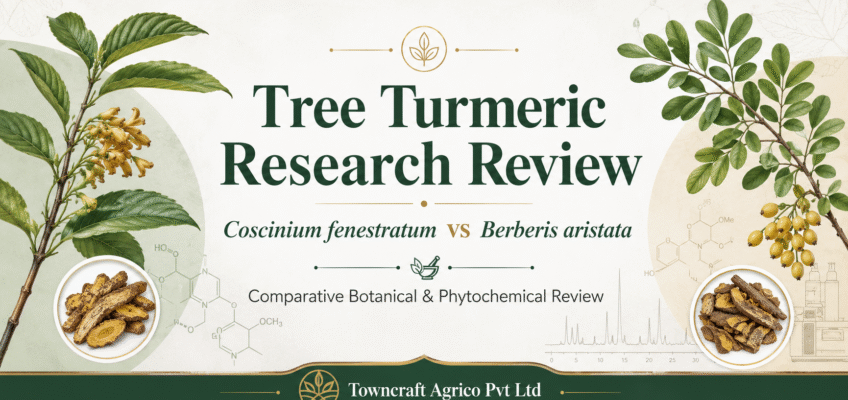
Comparative Botanical and Phytochemical Review of Coscinium fenestratum and Berberis aristata: Clarifying Tree Turmeric-Associated Medicinal Plant Identity in India
Article Type: Review Article / Technical Review
Title:
Comparative Botanical and Phytochemical Review of Coscinium fenestratum and Berberis aristata: Clarifying Tree Turmeric-Associated Medicinal Plant Identity in India
Author: Najeem M Illyas
Research Scholar
Qualification: M.Tech
Research performed at: Towncraft Agrico Pvt Ltd
Affiliation: Towncraft Agrico Pvt Ltd
Publication website: bangaloreagrico.in
Publication date: 06 July 2026
Document type: Review Article / Technical Review
Series: Towncraft Agrico Research Review Series
Suggested citation: Najeem M Illyas. Comparative Botanical and Phytochemical Review of Coscinium fenestratum and Berberis aristata: Resolving Tree Turmeric Nomenclature in Indian Medicinal Plant Research. Towncraft Agrico Research Review Series. 2026. Available at: https://towncraft.in/research/tree-turmeric-comparative-review/
Abstract
The common name Tree Turmeric is used in Indian medicinal plant discourse for more than one taxon, most notably Coscinium fenestratum (Gaertn.) Colebr. and Berberis aristata DC. This creates practical ambiguity in taxonomy, pharmacognosy, conservation planning, medicinal plant trade, cultivation, and research communication. This review compares the two species from botanical, ecological, phytochemical, and research perspectives. Coscinium fenestratum is a woody climber of the family Menispermaceae, associated with moist tropical forests and known in South India as Maramanjal. Berberis aristata is a thorny shrub of the family Berberidaceae, widely known as Daruharidra or Indian barberry and associated mainly with temperate and sub-Himalayan regions. Both are connected with yellow-coloured medicinal tissues and berberine-related phytochemistry, but they differ strongly in habit, ecology, plant part usage, conservation requirements, propagation strategies, and research priorities. The review concludes that the label Tree Turmeric should not be used alone in research or plant documentation. Scientific names, regional common names, voucher-based identification, and source-location details are necessary to avoid misidentification and to support reproducible medicinal plant research.
Keywords
Tree turmeric, Coscinium fenestratum, Berberis aristata, Maramanjal, Daruharidra, berberine, medicinal plants, phytochemistry, conservation, pharmacognosy
Article Summary
The common name Tree Turmeric can refer to more than one medicinal plant. This Towncraft Agrico research article compares Coscinium fenestratum and Berberis aristata from botanical, phytochemical, conservation, pharmacognostic, and research-documentation perspectives.
Full Article
The full searchable PDF is available above. The PDF should be placed in the same folder as this article page or linked with the absolute URL after uploading to the Towncraft website.
